
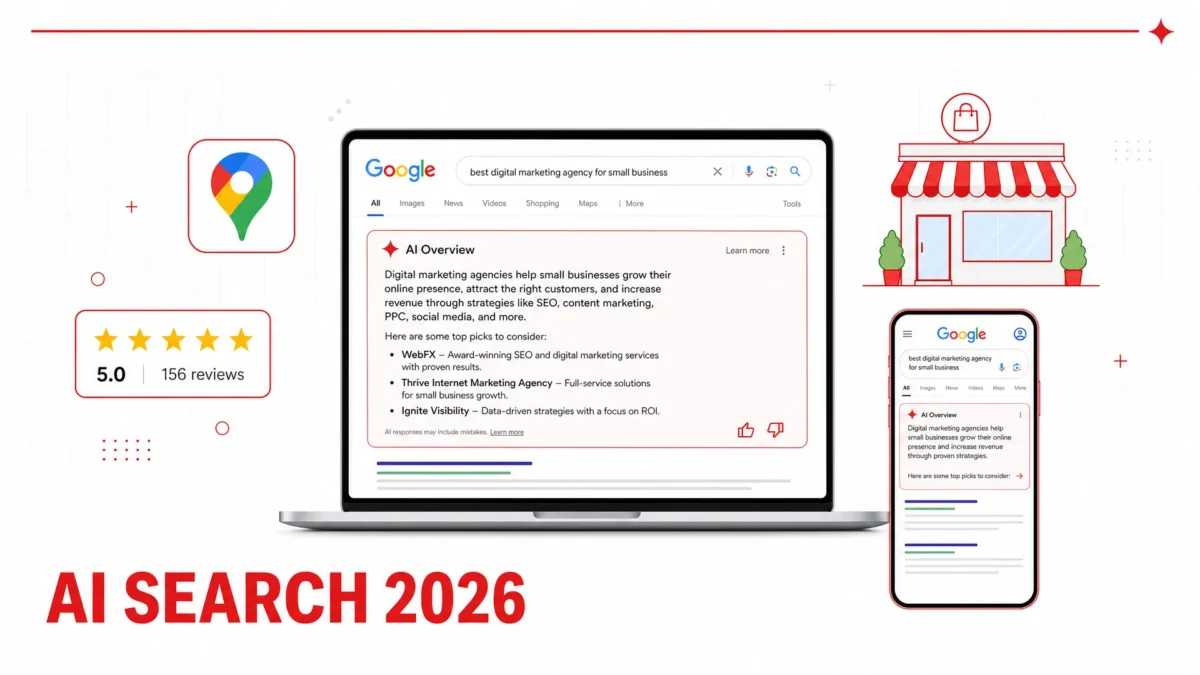
Something important happened last week that most small business owners have not heard about yet.
Google published a brand new guide specifically on how websites should optimize for its generative AI features, including AI Overviews and AI Mode. It is the first time Google has put this guidance in writing in one place, and it covers exactly what you should do, what you can stop worrying about, and what tactics are actively hurting you.
The timing matters. The May 2026 Core Update began rolling out just hours ago, making this one of the most consequential weeks for search visibility in recent memory. If your business relies on Google to bring in customers, this is the week to pay attention.
This article breaks down Google’s new AI search guidance in plain language, with five specific actions you can take right now without any technical background.
Why Google Published This Guide Now
For the past year, the marketing industry has been flooded with advice about “AEO” (Answer Engine Optimization) and “GEO” (Generative Engine Optimization). Consultants have been charging premium rates to help businesses “optimize for AI search.” New tactics have been circulating constantly: create llms.txt files, chunk your content into tiny pieces, rewrite everything in a specific AI-friendly format.
Google has now officially addressed all of this. Their message is direct: most of it is unnecessary, and some of it is counterproductive.
“AEO and GEO are both terms you may see used to describe work specifically focused on improving visibility in AI search experiences,” Google writes. “From Google Search’s perspective, optimizing for generative AI search is optimizing for the search experience, and thus still SEO.”
In other words, the fundamentals have not changed. What has changed is how Google’s AI systems surface and present content, and understanding that shift is what gives small businesses a real advantage right now.
What Google’s AI Search Actually Does
Before getting into the five actions, it helps to understand what is actually happening when Google shows an AI Overview or AI Mode response.
Google’s AI search features use a technique called retrieval-augmented generation, or RAG. When someone searches, Google’s AI does not just make up an answer. It pulls relevant pages from its search index, reads them, and generates a response based on what it finds. The pages it pulls from are the same pages that rank well in traditional search.
This is the key insight: if your content ranks well in regular Google Search, it is already in the pool of content that Google’s AI can draw from. You do not need a separate AI strategy. You need a better SEO strategy.
Google also uses what it calls “query fan-out,” where a single search triggers multiple related queries to gather more information. A search for “best HVAC company near me” might trigger fan-out queries about reviews, pricing, certifications, and service areas. This means your content needs to answer not just the obvious question but the surrounding questions your customers are likely to have.
5 Things to Do This Week
1. Stop Doing the Things That Do Not Work
The most immediately useful part of Google’s guide is the list of tactics you can stop spending time on. This is rare: Google almost never tells you explicitly what not to do.
Stop creating llms.txt files. These are special text files that some consultants have been recommending to help AI systems understand your site. Google says you do not need them. They are not treated in any special way.
Stop chunking your content. Breaking your pages into tiny pieces to make them easier for AI to process is not necessary. Google’s systems can understand nuance across a full page. There is no ideal page length.
Stop rewriting content just for AI. You do not need to write in a specific format for AI systems. Google’s AI can understand synonyms and general meaning, so you do not need to obsess over long-tail keyword variations or exact-match phrases.
Stop seeking fake mentions. Some agencies have been pitching “AI mention campaigns” where they try to get your brand mentioned across forums and blogs to boost AI visibility. Google explicitly says this does not work and can be flagged as spam.
If you have been paying for any of these services, this is a good time to reassess.
2. Make Your Content Non-Commodity
This is the single most important thing Google says in the entire guide, and it is the one most small businesses are getting wrong.
Google distinguishes between commodity content and non-commodity content. Commodity content is the kind of thing anyone could write: “7 Tips for First-Time Homebuyers,” “How to Choose a Plumber,” “Benefits of Regular HVAC Maintenance.” It is based on common knowledge, it adds nothing unique, and it could easily be generated by an AI model.
Non-commodity content is different. Google gives a specific example: “Why We Waived the Inspection and Saved Money: A Look Inside the Sewer Line.” That is a first-hand account with a specific point of view, grounded in real experience. AI cannot replicate it. Another AI cannot summarize it into nothing. It stands on its own.
For small businesses, this is actually an advantage. You have something large brands and content farms do not have: real experience, real customers, real local knowledge. The HVAC company that writes about what they actually found in homes in their city during the winter of 2025 is creating content no one else can create.
Ask yourself: what do you know about your customers and your market that no one else knows? Write that. That is the content Google’s AI will surface.
3. Fix Your Google Business Profile
This one is often overlooked in AI search conversations, but Google specifically calls it out in their guide.
Generative AI responses can include information about local businesses directly in the answer. When someone searches “best dentist near me” or “roofing company in Austin,” Google’s AI can pull from Google Business Profile data to populate that response.
If your Google Business Profile is incomplete, outdated, or inconsistent with your website, you are leaving visibility on the table. Google’s guide recommends using Google Business Profiles to help your services appear in both AI responses and traditional search results.
The basics matter here: make sure your hours are current, your service areas are listed, your categories are accurate, and you have recent photos. Reviews are also a signal, both in traditional local search and in AI responses. A business with 200 recent reviews is far more likely to be surfaced in an AI response than one with 12 reviews from three years ago.
4. Organize Your Pages for Human Readers
Google’s guidance on technical structure is more nuanced than it used to be. The core message is: build your site for human readers, and the technical side will largely take care of itself.
Specifically, Google says to use headings and paragraphs to create clear structure, make sure your site loads fast and displays well on mobile, reduce duplicate content, and use Search Console to identify and fix technical issues. If Google cannot properly crawl your pages, they cannot appear in AI responses.
One thing Google clarifies: you do not need perfectly semantic HTML. The web is full of imperfect code and Google handles it. What matters is that your content is readable, structured, and crawlable.
Page experience also matters directly. Google’s guide explicitly states that providing a good page experience for those who arrive at your site, including ensuring your site displays well across all devices and reducing latency, is part of what makes content eligible for AI features.
5. Add High-Quality Images and Video to Key Pages
This is one of the most underutilized opportunities for small businesses in AI search.
Google’s guide explicitly states that generative AI features can surface images and video alongside web page links, which means your content has more ways to appear in search results than just a blue link. If your pages have high-quality, relevant images and videos, they can appear in AI responses in ways that text-only pages cannot.
For a local business, this is practical and achievable. A before-and-after photo gallery for a home services company. A short video walkthrough of your office or shop. A photo of your team at a job site. These are not just good for social media. They are now a direct input into how Google’s AI can represent your business in search results.
Google also notes that if you are already following image SEO best practices, such as descriptive file names, alt text, and proper sizing, you are already optimizing for AI search. There is no separate image strategy needed.
What the May 2026 Core Update Means in This Context
The timing of Google’s AI search guide and the May 2026 Core Update rolling out simultaneously is not a coincidence. Core updates are how Google adjusts its ranking systems to better reflect its quality guidelines.
The businesses most likely to be negatively affected by this update are those that have been producing commodity content at scale, relying on AI-generated text without adding unique value, or pursuing the kinds of tactics Google just explicitly called out as ineffective.
The businesses most likely to benefit are those with genuine expertise, real customer relationships, and content that reflects actual experience. That description fits most small businesses better than it fits large content operations.
If you see ranking changes over the next two weeks as the update rolls out, do not panic and do not make major changes immediately. Core updates take time to settle. Use the time to review your content against Google’s new guidance and identify where you can add more genuine value.
Key Takeaways
Google’s new AI search guide confirms that the fundamentals of good SEO remain unchanged. The businesses that will win in AI search are the ones creating content that reflects real expertise and experience, maintaining accurate local business information, and building technically sound websites that load fast and display well.
The tactics to stop doing immediately: llms.txt files, content chunking, rewriting for AI, and seeking fake mentions. None of them work, and some of them can hurt you.
The one action that matters most: create content that only you can create. Your real experience, your local knowledge, your specific customers. That is what Google’s AI is designed to surface, and it is something no competitor can replicate.
Frequently Asked Questions
Is SEO still relevant now that Google has AI search?
Yes. Google’s own guide confirms that its AI features are built on the same ranking and quality systems as traditional search. If your content ranks well in regular Google Search, it is already eligible to appear in AI Overviews and AI Mode. You do not need a separate AI strategy.
What is the difference between commodity and non-commodity content?
Commodity content is generic information that anyone could write, such as “tips for first-time homebuyers.” Non-commodity content is specific, experience-based, and unique to you, such as a detailed account of a real customer situation you handled. Google’s AI systems are designed to prefer non-commodity content because it provides genuine value that AI cannot replicate.
Do I need to create an llms.txt file for my website?
No. Google explicitly states in its new guide that llms.txt files are not required and are not treated in any special way by Google Search. You can ignore this tactic entirely.
How does my Google Business Profile affect AI search?
Google’s AI responses can include local business information pulled directly from Google Business Profiles. Keeping your profile complete, accurate, and up to date with recent reviews and photos increases your chances of appearing in AI-generated local search responses.
Should I rewrite my existing content for AI search?
No. Google says you do not need to write in a specific format for AI systems. Focus on making your content genuinely useful and unique for human readers. That is what Google’s AI is designed to surface.
What should I do if my rankings drop during the May 2026 Core Update?
Do not make major changes immediately. Core updates take up to two weeks to fully roll out. Use the time to review your content against Google’s new guidance, focusing on whether your pages offer unique value and genuine expertise. Avoid reactive changes based on early data.

Leave a Reply